 |
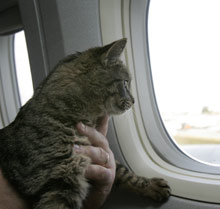
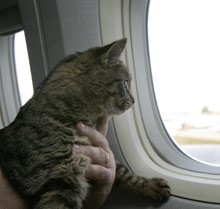
| Emily Aboard Continental Airlines on Her Way Home |
"Only a Frenchman could understand the fine and subtle qualities of the cat."
-- Théophile Gautier
Curiosity has claimed the life of more than one cat. So, too, has unescorted roaming.
This world is, unfortunately, full of dangers and evil people that the feline brain can never hope to comprehend. When Emily, a thirteen-month old brown and gray cat from Appleton, Wisconsin, wandered into the distribution center of a local paper company little did she know that this would be the beginning of a two-month odyssey that would take her to France and back home again.
Emily is an adventurous cat. According to her guardians, Donny and Lesley McElhiney, she has left home before and even once spent two weeks in an animal shelter before they were able to locate and reclaim her. When she pussyfooted into the paper distribution plant back in late September she got more than she bargained for in terms of adventure and it nearly cost her all nine of her lives.
She somehow got trapped inside a twenty-foot cargo container filled with rolls of paper that was then trucked to Chicago. From the Windy City the container was sent on a four-day train trip to Halifax, Nova Scotia, where it was offloaded onto a cargo ship bound for Antwerp, Belgium. From there Emily was forced to endure another one-week sea voyage to Pompey, France, at which juncture the cargo container was unloaded once again and trucked an additional ten kilometers to its final destination in Nancy, a city of one-hundred-three-thousand inhabitants and located two-hundred-eighty-one kilometers west of
gai Paris.
When the container was finally opened on October 24th at Raflatac, a laminating and labeling company, the French workers were surprised to find a cat inside. They immediately dubbed the thirsty and hungry cat
Raflacat.
 |
| Emily and George Chiladze on the Plane |
The fact that she had survived more than three weeks without food and water is a miracle in itself. Moreover, the loneliness, fear, despair, and claustrophobia that she must have experienced during her long ordeal would have been far too much for most humans. Somehow and some way she lived through it all and, ironically, her rescue came on the date of her first birthday!
According to press reports, the French authorities usually kill stray cats but the employees of Raflatac used information contained on Emily's collar in order to notify her veterinarian in Appleton who in turn contacted the McElhineys. Ironically, she was not even wearing her own collar but rather one that belonged to another of the McElhineys' cats. That certainly was in keeping with her history of divesting herself of collars but luckily this time she had one around her little neck.
Since under French law all immigrant pets must be quarantined for thirty days, Emily spent the following month in detention which Raflatac generously paid for to the tune of $7 per day. "Only a Frenchman could understand the fine and subtle qualities of the cat,"
Théophile Gautier once observed and evidently there is more than a little bit of truth in his declaration.
Once her confinement was over, Continental Airlines then stepped forward and generously volunteered to fly Emily home for free.
"I will make somebody really happy to deliver this poor traveler back home." company employee George Chiladze, who accompanied Emily on the first leg of her trip home from Charles de Gaulle Airport, thirty kilometers north of Paris, to Newark, told the CBC on December 1st.
(See "The Cat Has Landed Back in Wisconsin.")
Emily and George traveled in a business-class seat that normally sells for $6,000. "I think she deserves business," airline spokesperson Philippe Fleury told the CBC. "I don't think she will drink champagne anyway, but I think she will be happy to rest."
 |
| Emily Waits Patiently at Charles de Gaulle Airport |
As to why Continental took the initiative, Fleury said only that since it was such a "marvelous story" the airline wanted to add "something to it." Although the young cat was alert for takeoff , she reportedly slept most of the way to Newark. When feeding time came she, with typical feline
insouciance, turned up her dainty little nose at the business-class fare of peppered salmon fillet and instead opted for a more mundane bowl of French cat food and water.
At Newark International, George handed over Emily to Continental Airlines cargo agent Gaylia McLeod who accompanied her the remainder of the way to General Mitchell International Airport in Milwaukee aboard a fifty-seater. "I know it's close to the holidays," McLeod said. "I'm happy to be a part of reuniting Emily with her family."
Upon her arrival in Brew Town last Thursday evening, Emily was greeted by a mob of reporters, photographers, and cameramen who were on hand to record her reunion with the McElhineys and their nine-year old son, Nicky, all of whom had driven one-hundred-seventy-three kilometers from Appleton in order to collect her. "She'll be held onto a lot," Donny told the
Los Angeles Times on December 2nd.
(See "Stowaway Cat Back Home After a Long Trip to France.") "She's a great present."
Commenting on Emily's grueling ordeal, his wife, Lesley, noted that "the diva," as she calls her, had probably used up a good deal of her nine lives. "She probably has half a life left," she added.
 |
| Emily Is Reunited with Donny, Lesley, and Nicky McElhiney in Milwaukee |
In addition to Donny, Lesley, and Nicky, Emily will be sharing quarters with Abbey, Nicky's five-year old sister, and resident felines eleven-year-old Tori and seven-year-old Ringo at the McElhiney household in Appleton, a town of seventy-thousand residents one-hundred-forty-two kilometers north of Milwaukee. Although the globetrotting feline is now officially grounded, Lesley admits that keeping her at home will not be easy because she likes to hide when the door is left open and knows when a person's hands are full. That may be even more the case now that she has seen France and become accustomed to French cuisine.
There may be a more deep-seated motivation behind Emily's perambulations and collar sheddings other than a love of adventure. It is entirely possible that the McElhiney household with two other cats and two young children is simply too busy and noisy for her tastes. Cats, after all, like peace, quiet, and to be left alone.
It would be a nice gesture on the part of the McElhineys if they were to send the employees of Raflatac a few pounds of Wisconsin cheese to go along with their excellent
le vin de francaise. After all, it was their concern and generosity that saved Emily's life.
Emily's triumph against all odds brings to mind the remarkable story of a shorthaired black cat named Cheyenne who made headlines last year. On April Fools Day in 2004 she was discovered walking down Divisadero Street in San Francisco and taken to a local shelter where a scan of an implanted microchip revealed that she had disappeared from Bradenton, Florida, seven years previously! She later was reunited with her previous caregiver, Pamela Edwards, thanks to air transportation paid for by actress Ellen DeGeneres.
 |
| Emily and Nicky Share a Tender Moment |
Edwards had originally believed that Cheyenne had fallen prey to either alligators or some other catastrophe and was dead. Officials at the shelter surmised, however, that a far more likely scenario was that she had been picked up by someone in Florida who had then either driven or flown her to California. Of course, it is always possible that she could have gotten trapped inside a moving crate like Emily and therefore wound up on the West Coast.
"She has glossy fur, good weight," Deb Campbell of the Department of Animal Care and Control (DACC) told the
San Francisco Chronicle on April 22, 2014.
(See "Missing Florida Cat Shows Up in San Francisco -- Seven Years Later.") "She definitely looks in good condition, so I don't think she walked here."
Edwards had adopted Cheyenne in 1997 from a shelter in Manatee County, Florida, which was among the first in the state to implant microchips in cats and without that revolutionary identification device it is highly unlikely that the duo ever would have been reunited."For a cat missing across the country to be found several years later, that's a first for me," Mara Lamboy of the DACC told the
Chronicle in the article cited
supra. "That connection never in a million years would have been made without a microchip."
Like Emily, Cheyenne was returned to a crowded household in that Edwards has acquired three new cats since her disappearance. "I feel sorry for Cheyenne because I'm sure she doesn't remember me," she told the
Chronicle. "I'm hoping that she'll merge nicely with our other cats."
 |
| Cheyenne and Mara Lamboy |
As the examples of Emily and Cheyenne conclusively demonstrate, cats lead not only secretive and solitary existences, but precarious ones as well. In addition to being poisoned, intentionally run down by motorists, and preyed upon by ailurophobes and dogs, they can be either stolen or become trapped inside shipping containers.
Equipping a cat with a collar is a good idea if the cat can be persuaded to wear it and not shed it at the first opportunity like Emily has been known to do. Collars do, however, have one huge limitation: they can be easily removed by cat thieves.
Microchipping is undoubtedly a surer method of protecting a cat but the devices must be surgically implanted and that requires the use of anesthesia and there is always the remote chance that a cat will not wake up after surgery. Infections resulting from the incision are another concern.
Cats need and should have their freedom but with it also comes risks. Cats given too much free rein sometimes wind up dead and that in turn breaks their owners' hearts. There is not any easy answer to this dilemma but the amount of freedom given to any cat should be weighed against the feline's prior history. For instance, is he or she accustomed to being out-of-doors? Also, the dangers present in the neighborhood must be taken into consideration.
Both Emily and Cheyenne are brave and remarkable cats who have suffered much and overcome much as well.
Photos: Christophe Ena of the Associated Press (Emily on plane and at airport check-in), Kirk Wagner of the Appleton Post-Crescent (Emily's homecoming), and Michael Macor of the San Francisco Chronicle (Cheyenne and Lamboy).